 how-to
Best Grind Size for Pour Over Coffee: A Dial-In Guide
Table of Contents
- What the Best Grind Size for Pour Over Coffee Looks Like
- Coffee Grind Size Chart: Coarse, Medium, and Fine Compared
- How to Grind Coffee for Pour-Over Without a Scale of Guesswork
- Brewer-by-Brewer Grind Settings: V60, Chemex, and Clever Dripper
- How to Adjust Coffee Grind Size When the Cup Tastes Off
- The Best Coffee Grinder for Pour-Over and What to Look For
- Water, Ratio, and Temperature: The Variables That Change Your Grind
- Frequently Asked Questions
Last Updated: October 15, 2026
What the Best Grind Size for Pour Over Coffee Looks Like
The best grind size for pour over coffee is a medium grind, close to the texture of regular sand.
That answer covers most setups, but it is only a starting point. At Diamond Grind Coffee, we roast small batches to order and ship the same day, and home brewers keep asking why the same recipe tastes different day to day.
This guide gives you a repeatable dial-in process, brewer-specific settings, and a way to read the cup.
Why Medium Grind Is the Starting Point
Grind size is the average particle size your grinder produces, measured in microns. Medium grind lands where water passes through the coffee bed in about two and a half to three and a half minutes on a standard pour over.
Think of it as surface area: finer particles expose more coffee to water and speed extraction, coarser particles expose less and slow it down. Medium balances the two because it matches the contact time a dripper naturally provides.
How Grind Size Affects Extraction, Taste, and Drawdown
Extraction is the process of dissolving flavor compounds from coffee grounds into water. Grind size controls how fast that happens.
- Too fine: water stalls, brew time stretches past four minutes, and the cup turns bitter and dry
- Too coarse: water drains in under two minutes, and the cup tastes weak, sour, or hollow
- Just right: drawdown finishes in the two-and-a-half to three-and-a-half minute window, and the cup tastes balanced
Drawdown is the time it takes for water to drain through the coffee bed after you finish pouring. It is your most useful signal: watch it and you will know which way to adjust before you even taste the coffee.
Coffee Grind Size Chart: Coarse, Medium, and Fine Compared
Pour over sits in the middle of the grind spectrum. Here is how the three main settings compare, along with the texture you should feel between your fingers.
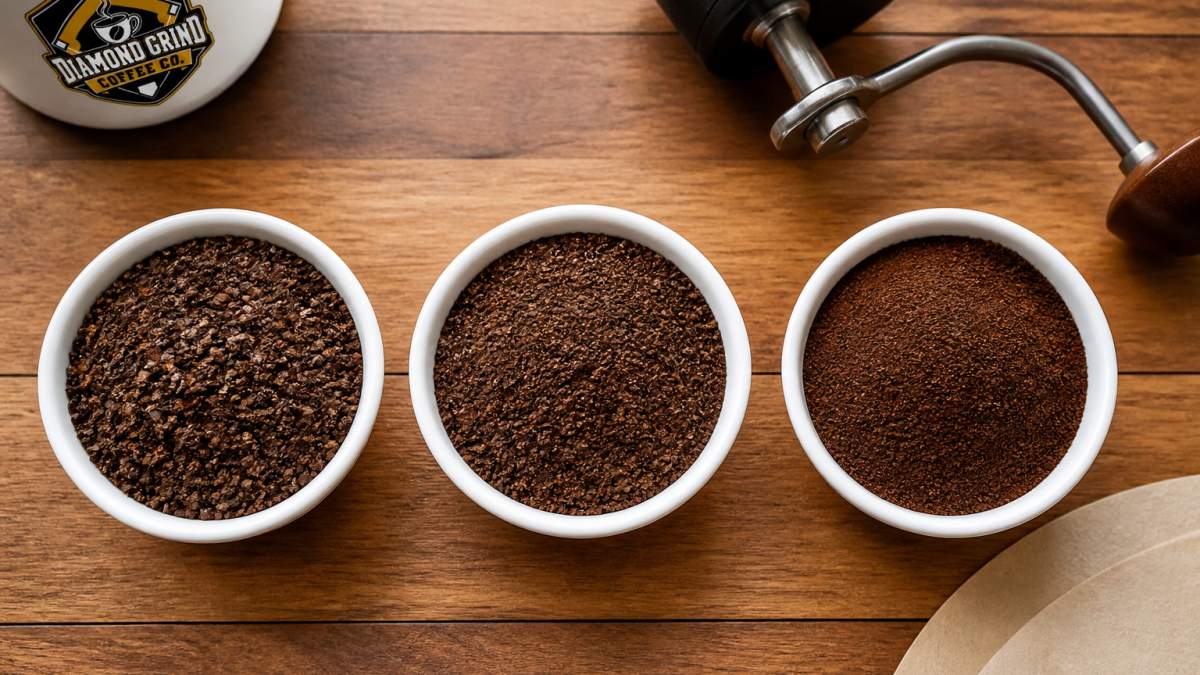
| Grind | Texture Reference | Typical Brew Time | Best Brewing Method |
|---|---|---|---|
| Coarse | Sea salt | 4+ minutes | French press, cold brew |
| Medium | Regular sand | 2.5-3.5 minutes | Pour over, drip coffee |
| Fine | Powdered sugar | Under 2 minutes | Espresso, moka pot |
Medium-fine sits between medium and fine. Some brewers use it for the V60 to push more brightness out of light roasts, a valid adjustment, not a mistake.
The texture test matters more than any number on a grinder dial.
How to Grind Coffee for Pour-Over Without a Scale of Guesswork
Learning how to grind coffee for pour-over comes down to one repeatable loop: set a starting point, brew, taste, adjust one variable, repeat.
- Start at medium. Set your grinder to the midpoint of its range, or the setting the manual lists for drip coffee.
- Weigh your coffee. Use 15 grams of ground coffee for a single cup.
- Weigh your water. Use 250 grams of water, heated to 200°F.
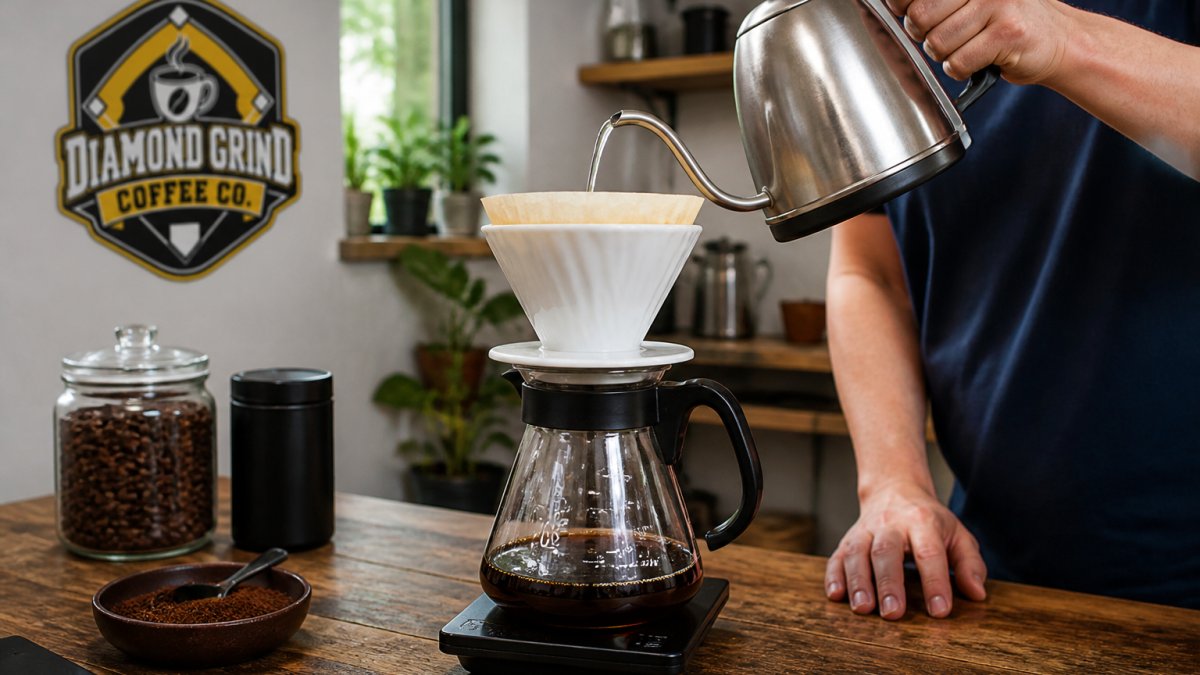
- Rinse the filter. Pour hot water through the paper filter and discard it. This removes paper taste and preheats the dripper.
- Bloom for 30 seconds. Pour 45 grams of water over the grounds and wait. The bed will puff and bubble.
- Pour in slow circles. Add the remaining water in two or three pours, keeping the bed level.
- Time the drawdown. Start your timer at the first pour. Note when the bed finishes draining.
- Taste and adjust. Sour or weak means go finer. Bitter or dry means go coarser.
Change one thing at a time, adjust grind and water temperature together and you will not know which one fixed the cup.
Brewer-by-Brewer Grind Settings: V60, Chemex, and Clever Dripper
Each pour over brewer has its own flow rate, which changes the grind it wants: a wide open hole drains faster than a thick filter. The starting points below assume a 15 g dose, a 1:16 ratio (250 g water), and water near 200°F.
| Brewer | Filter | Starting Grind | Target Drawdown | Why |
|---|---|---|---|---|
| Hario V60 (size 02) | Thin cone paper | Medium-fine | 2:30-3:00 | Wide single hole and thin paper drain fast, so a finer grind keeps contact time in range |
| Chemex (6-cup) | Thick bonded paper | Medium-coarse | 3:30-4:30 | The heavy filter slows flow; a coarser grind prevents a stall |
| Clever Dripper | Standard cone paper | Medium | 2:30-3:30 after valve release | The valve lets you control steep time, so grind matters less than immersion |
| Kalita Wave (185) | Flat-bottom paper | Medium | 3:00-3:30 | Three small holes and a flat bed even out flow, so medium works across roasts |
| Origami (small) | Cone paper | Medium-fine | 2:30-3:00 | Wide open base mimics a V60; finer grind compensates |
Filter type matters as much as the brewer. Thin paper filters drain faster than thick ones, and metal filters drain fastest of all, often needing a finer grind to compensate.
A Repeatable Dial-In Process for Any Brewer
Changing grind without a record is guessing. Use this loop, one variable at a time:
- Lock the recipe. Fix dose (15 g), water (250 g), temperature (200°F), and pour schedule before you touch the grinder.
- Set a starting grind from the table above.
- Brew and log the grind setting, dose, water weight, total brew time, and drawdown time.
- Taste and read the drawdown. Sour or thin with a fast drain means grind finer. Bitter or dry with a slow drain means grind coarser.
- Move one step. One click on a stepped grinder, a small nudge on a stepless one.
- Repeat. Two or three brews usually land you in range; five to ten builds a personal chart for that brewer and that coffee.
Why the Same Setting Tastes Different on Different Gear
Numbered settings are not universal. A "medium" can sit at 18 on one grinder, 5 or 60 on another, because manufacturers choose their own scale, and burr geometry, wear, and calibration drift all shift where a number lands.
If your grinder is new to you, calibrate by texture first: grind a small batch, rub it between your fingers, and compare it to regular sand, then brew and let the drawdown confirm it.
How to Adjust Coffee Grind Size When the Cup Tastes Off
Learning how to adjust coffee grind size is mostly a matter of reading two signals: taste and time. Taste tells you the direction. Time confirms it.
| Problem | Likely Cause | Fix |
|---|---|---|
| Sour, weak, thin | Under-extraction | Grind finer |
| Bitter, dry, harsh | Over-extraction | Grind coarser |
| Drawdown under 2 minutes | Grind too coarse | Grind finer |
| Drawdown over 4 minutes | Grind too fine | Grind coarser |
| Good taste, slow drain | Filter clogging | Coarsen slightly, check filter |
Move in small steps: one click on a stepped grinder, a tiny nudge on a stepless one. Big jumps make the sweet spot hard to find.
Reading Brew Time and Drawdown as Your Guide
Brew time is your fastest feedback loop.
Aim for two and a half to three and a half minutes total for a single cup, a window that holds for most pour over methods.
Water temperature and pour speed also move brew time, so before changing your grind, check that your water is near 200°F and you are pouring steadily. Fix the easy variables first.
The Best Coffee Grinder for Pour-Over and What to Look For
A burr grinder is the best coffee grinder for pour-over because it produces particles of a consistent size. Blade grinders chop coffee into dust and chunks that extract unevenly, giving you bitter and sour notes in the same cup.
Grind consistency is how uniform your particles are, and it matters more than any single setting. A tight particle distribution gives predictable extraction; a wide spread gives a cup that tastes under- and over-extracted at once.
Why Numbered Settings Vary Between Grinders
Every manufacturer picks its own scale: 18 might be medium on one grinder and fine on another. Three things drive the difference:
- Burr geometry. Flat burrs and conical burrs cut coffee differently, and burr diameter changes the particle distribution.
- Calibration. Burrs are set at the factory and can drift with use. Two identical models can sit at different zero points.
- Burr wear. Dull burrs produce more fines and a wider spread, so the same number grinds differently after a year of daily use.
That is why a generic grind chart can only tell you the texture to aim for, not your setting.
Fines, Boulders, and What They Do to Your Cup
Even a good burr grinder produces a range of particle sizes. The two extremes matter most:
- Fines are the dust-like particles. They extract fast and can clog a paper filter, slowing drawdown and adding bitterness.
- Boulders are the oversized chunks. They extract slowly and leave the cup thin or sour.
Fewer fines and boulders mean a narrower window to dial in. If drawdown is erratic brew to brew at the same setting, fines are often the cause, coarsening slightly can reduce clogging even when the average particle size is correct.
What to Look For
- Burr type: flat or conical burrs both work well for pour over; flat burrs tend to produce a more uniform grind, conical burrs are often more forgiving.
- Adjustability: stepless or fine-stepped adjustment lets you dial in small changes. Coarse-stepped grinders make it hard to move one click at a time.
- Consistency: uniform particles mean predictable extraction. This is the spec that matters most for pour over.
If you buy pre-ground coffee, ask for a medium grind sized for drip or pour over. It works, but starts losing aroma the moment it is ground; whole bean ground right before brewing gives the best result.
Our single origin coffees, like our Brazil Santos, ship as whole bean or ground to your preference. A medium roast with cocoa notes holds up well to a medium pour over grind.

Water, Ratio, and Temperature: The Variables That Change Your Grind
Grind is not the only lever, and the other levers change what grind you need.
Coffee-to-water ratio is the weight of coffee compared to water.
Water quality affects extraction: water too hard or too soft changes how well flavor compounds dissolve.
Water temperature should sit near 200°F. Cooler water extracts more slowly, which can make a correct grind taste under-extracted.
A note on freshness: coffee releases carbon dioxide for days after roasting, and that gas can disturb the bloom and slow your pour. Let freshly roasted beans rest a few days, then use them within a few weeks for the brightest cup.
Grind size trips up more pour over brews than any other variable.
Diamond Grind Coffee roasts every small-batch order the day it ships, so you are dialing in coffee at its freshest. Choose whole bean or a custom grind, including coarse, standard, or espresso, and explore single origins through sample packs with free shipping on U.S. orders.
Frequently Asked Questions
What grind size is best for pour-over coffee?
Start with a medium grind, close to the texture of regular sand. That setting works for most pour over drippers and paper filters. From there, adjust by taste: if the cup tastes sour or weak, grind finer; if it tastes bitter or harsh, grind coarser. A medium grind paired with a 1:16 coffee-to-water ratio gives you a reliable baseline before you start dialing in.
How do I know if my pour-over grind is too fine or too coarse?
Watch your brew time and taste. A pour over that stalls past about 4 minutes and tastes bitter usually means the grind is too fine, because water struggles through the bed. A brew that finishes in under 2 minutes and tastes sour or watery means the grind is too coarse. Check the spent grounds too: fine grinds look powdery, coarse grinds look like sea salt.
How should I adjust grind size if my pour-over tastes bitter?
Grind coarser in small steps, about one click or one setting at a time, and brew again with the same dose and water weight. Bitter, dry, or harsh flavors point to over-extraction, which happens when water pulls too much from the grounds. If the taste improves but turns sour, you went too far and should move back half a step.
Is it worth buying a coffee grinder for pour-over?
Yes, if you want consistent results. Pre-ground coffee is usually too fine or too coarse for a pour over, and you cannot adjust it. A burr grinder gives you even particle size and repeatable settings, which is what makes dialing in possible. Blade grinders produce uneven grounds that brew unevenly, so a burr grinder is the better investment for pour over.