 how-to
How to Tell if Coffee Is Fresh: A Complete Guide
Table of Contents
- Why Coffee Freshness Matters
- How to Tell If Coffee Is Fresh: The Aroma Test
- Visual Indicators: Appearance and Surface Oils
- Reading the Roast Date and Understanding Peak Freshness
- Signs Coffee Beans Are Stale
- How to Store Coffee Beans to Keep Them Fresh
- How Long Do Coffee Beans Stay Fresh
- Can Coffee Beans Be Too Fresh to Brew
- Frequently Asked Questions
Last Updated: October 17, 2026
Why Coffee Freshness Matters
Fresh coffee tastes better, and that changes everything about your morning cup.
Freshly roasted coffee releases bold, vibrant flavors you won't find in stale beans: the aromatic compounds are alive, the flavor-carrying oils are present, and extraction happens as it should. As days pass, those compounds break down, the oils oxidize, and the flavor flattens.
At Diamond Grind Coffee, we roast small batches the same day they ship. A coffee that tastes flat and muted from a grocery store shelf becomes complex and alive when it arrives fresh.
Freshness also affects brewing behavior. Stale beans extract differently, producing weaker shots and muddy, over-extracted cups. Fresh beans respond predictably to your brewing method and deliver the flavor profile the roaster intended.
Understanding how to tell if coffee is fresh is the first step to getting better coffee at home. You need to know what you're looking for.
How to Tell If Coffee Is Fresh: The Aroma Test
The smell test is your most reliable tool for detecting freshness. Fresh coffee has a strong, complex aroma. Stale coffee smells faint and flat.
Open a bag of fresh beans and the aroma hits immediately, bold, inviting, filling the space around you. That scent comes from volatile aromatic compounds released during roasting, which break down over time, especially once the bag is opened.
Here's what to listen for when you smell fresh coffee beans:
- Strong, immediate aroma, The smell hits you right away, not gradually
- Complex notes, You can detect layers: chocolate, fruit, nuts, florals, depending on the origin
- Pleasant intensity, The aroma is inviting, not sharp or burnt
- Consistency throughout the bag, Every handful smells the same
Stale coffee smells faint, dull, sometimes musty or flat, you have to work to detect any aroma at all.
The aroma test works best with whole beans; ground coffee loses its smell faster because grinding exposes more surface area to oxygen. If you buy pre-ground, smell it immediately after opening, barely any aroma means it has already begun to fade.
Visual Indicators: Appearance and Surface Oils
What fresh coffee looks like matters. The appearance tells you a lot about what's inside.
Fresh whole beans have a glossy appearance, a subtle sheen of natural coffee oil, a sign the beans are still releasing flavor-carrying compounds. Color is rich and deep, varying by roast level: light roasts appear darker brown with a matte finish, dark roasts shiny and almost wet.
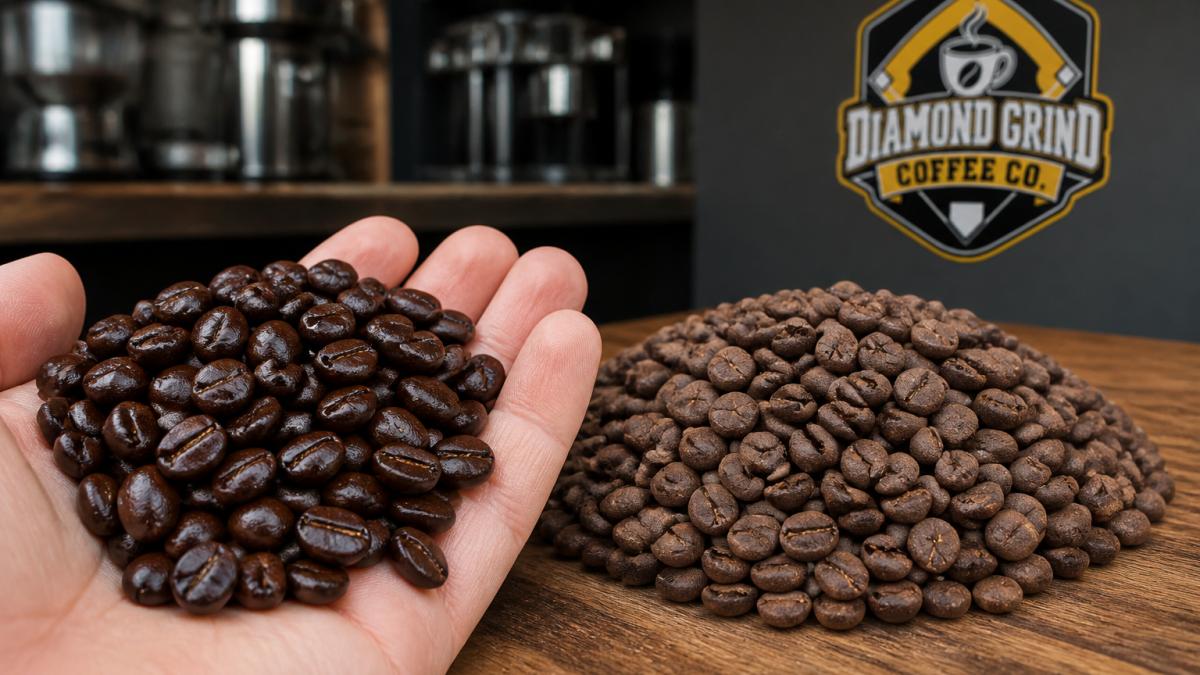
Stale beans look dull and lifeless, with no shine and a faded or grayish color. A dusty or chalky coating means they've been exposed to air too long.
Here's what to check:
- Surface sheen, Fresh beans have visible oils; stale beans look dry
- Color depth, Fresh beans show rich, consistent color; stale beans appear faded
- Texture appearance, Fresh beans look smooth; stale beans may look cracked or chalky
- Uniformity, All beans in a fresh bag look similar; stale batches may show uneven discoloration
The oils on fresh beans aren't a flaw, they signal the coffee is still releasing flavor compounds. Once those oils oxidize, the flavor goes with them.
Not all fresh coffee looks the same: light roasts have less visible oil than dark roasts because roasting stops earlier. But even light roasts should have some sheen and rich color, completely matte and pale means likely stale.
Reading the Roast Date and Understanding Peak Freshness
The roast date is your most important piece of information. It tells you exactly when the coffee was roasted.
Look for the roast date printed on the bag, ideally within the last two weeks for optimal freshness. Some bags show it on the front, others on the back or side, so check everywhere before assuming it's missing.
Understanding what the roast date means helps you make smart decisions:
- 0-3 days after roasting, Peak freshness for espresso and pour-over. The coffee has finished degassing but retains maximum flavor compounds.
- 3-7 days after roasting, Excellent for most brewing methods. Still vibrant and complex.
- 7-14 days after roasting, Good for most uses. Flavor is stable but beginning to fade.
- 14-30 days after roasting, Acceptable but noticeably less bright. The coffee is past its prime.
- 30+ days after roasting, Stale. Flavor has flattened significantly.
Peak freshness depends on roast level and brewing method. Dark roasts taste good a bit longer because the longer roast already broke down some volatile compounds; light roasts peak earlier because more delicate flavors are at stake. Espresso pulls different compounds than pour-over, so the same coffee may taste fresher for espresso.
When you order from Diamond Grind Coffee, the roast date arrives fresh. We roast your order the same day it ships. That means you're getting coffee at or near its peak freshness window.
Many coffee drinkers overlook the roast date, focusing on origin or roast level instead. That's a mistake: a two-month-old coffee from an excellent origin tastes worse than a one-week-old coffee from an average origin. Freshness beats everything else.
Signs Coffee Beans Are Stale
Stale coffee shows itself in multiple ways. Learn the signs and you'll never drink flat coffee again.
The most obvious sign is the smell test. If you open a bag and barely detect any aroma, the coffee is stale. Fresh coffee announces itself. Stale coffee is quiet.
Here are the other signals:
- Faint or musty aroma, Little to no smell, or a dull, flat scent
- Dull, matte appearance, No shine on the beans, faded color
- Weak brewed coffee, The cup tastes thin and flat, lacking complexity
- Over-extraction issues, The coffee tastes bitter or muddy even with proper brewing
- No crema on espresso, Espresso shots pull without the thick layer of crema on top
- Slow degassing, Fresh beans bubble visibly when hot water hits them; stale beans don't
- Absence of roast date, No date printed on the bag, or a date older than 30 days
Ground coffee goes stale faster than whole beans. If you buy pre-ground, check the aroma immediately after opening, it loses freshness within days, sometimes hours, depending on prior storage.
Best Sellers Sample Pack: 6Bean, Cowboy, Breakfast, Peru, Mexico, Bali →
The taste test is definitive. Fresh coffee has brightness, complexity, and a clean taste; stale coffee tastes flat, lacks clarity, and may be slightly bitter or musty. Once you've tasted fresh coffee, stale coffee becomes obvious.
How to Store Coffee Beans to Keep Them Fresh
Where you store coffee matters as much as when you brew it. The right storage keeps beans fresh longer.
Coffee's enemies are oxygen, moisture, heat, and light, exposure to any speeds up staling, so minimize it.
Store whole beans in an airtight container, glass jars with airtight seals work well, and opaque beats clear because it blocks light. Keep it in a cool, dark place like a pantry or cabinet away from the stove. Avoid the refrigerator: temperature fluctuations and moisture accelerate staling.
If the original bag has a one-way valve, you can store beans in it, the valve lets carbon dioxide escape without letting oxygen in. Fold the top down, seal it, and keep it cool and dark.
Here's the storage strategy:
- Whole beans, Store in an airtight container in a cool, dark place for up to 30 days
- After opening, Use within 2-3 weeks for peak flavor
- Ground coffee, Use within 3-5 days of grinding for best results
- Freezer storage, Not recommended for long-term storage; condensation damages flavor
Some people freeze coffee to extend its life. That's a mistake: freezing introduces moisture through condensation and locks in flavors at the point of freezing. For most home brewers, buying smaller quantities more frequently beats stretching old coffee.
Buy what you'll use in two to three weeks. Whole beans stay fresher longer than ground, so grind just before brewing, the longer ground coffee sits, the more flavor you lose.
How Long Do Coffee Beans Stay Fresh
The timeline for coffee freshness is shorter than many people think. Fresh whole beans are at their best for about two weeks after roasting, when flavor is brightest and most complex; after that, it fades noticeably.
Here's the freshness timeline:
- Days 1-3, Peak for espresso and pour-over. Maximum complexity and brightness.
- Days 3-7, Excellent for all brewing methods. Still vibrant and full-flavored.
- Days 7-14, Good for most brewing. Flavor is stable but beginning to flatten.
- Days 14-21, Acceptable but noticeably less bright. The coffee is fading.
- Days 21-30, Stale. Flavor has flattened significantly.
- 30+ days, Very stale. Most people notice a dull, flat taste.
Ground coffee has a shorter window: grinding exposes beans to oxygen, so grind just before brewing. If you must grind ahead, use it within a few hours.
Storage conditions change the timeline: coffee in a cool, dark, airtight container lasts longer than coffee exposed to heat, light, and air, and coffee at room temperature in a clear container stales faster.
Roast level also matters: dark roasts taste acceptable a bit longer because roasting already broke down some volatile compounds, while light roasts peak earlier because delicate flavors are vulnerable to oxidation.
When you order from Diamond Grind Coffee, the beans arrive fresh. Because we roast the same day we ship, you receive coffee that's just beginning its freshness window.
Can Coffee Beans Be Too Fresh to Brew
This is a common question. The answer is yes, but not in the way most people think.
Coffee releases carbon dioxide for the first few days after roasting, a process called degassing (Time-Resolved Gravimetric Method To Assess Degassing of Roasted Coffee).
For pour-over and immersion brewing, the window is wider: beans 1-3 days old usually work fine, since the process allows enough time for proper extraction despite ongoing degassing.
Here's the practical timeline:
- 0-24 hours old, Best for espresso: wait until day 2
- 1-3 days old, Good for all brewing methods
- 3-7 days old, Excellent for all brewing methods
- 7-14 days old, Good for all brewing methods
- 14+ days old, Acceptable but flavor is fading
If your beans are less than 24 hours old, wait a day or two before brewing espresso; for other methods, brew immediately, the coffee will taste excellent.
This is minor compared to stale coffee. Most home brewers never encounter beans that are too fresh; the bigger issue is waiting too long.
The degassing window is short: by day 3 or 4, heavy degassing has finished and the beans perform their best across all brewing methods.
Knowing how to tell if coffee is fresh transforms your coffee experience. The aroma, appearance, roast date, and storage all matter. Fresh coffee tastes noticeably better than stale coffee.
Start with the roast date. Explore our Best Sellers Sample Pack or Single Origin Favorites Sample Pack to discover fresh, bold coffee delivered to your door. SHOP FRESH and experience what peak freshness tastes like.


Frequently Asked Questions
How long do coffee beans stay fresh after roasting?
Whole beans peak in freshness 3-10 days after roasting as CO2 degassing continues, then remain flavorful for 2-4 weeks in an airtight container. Ground coffee loses freshness faster, staying optimal for 3-7 days. Diamond Grind Coffee ships beans the same day they are roasted, so they arrive during peak freshness. Storage conditions matter: heat, light, and oxygen accelerate flavor loss.
Can coffee beans be too fresh to brew?
Yes. Beans roasted fewer than 24 hours ago release excess CO2 during brewing, causing uneven extraction and a sour taste. A short resting period of 24-48 hours allows CO2 to escape naturally, improving extraction and flavor balance. This is especially noticeable with espresso, where consistent pressure and contact time require stable degassing. After this brief rest, beans are ideal for brewing.
What are the main signs coffee beans are stale?
Stale beans show a dull, flat appearance with little to no surface oils, emit a faint or absent aroma, and taste flat or bitter in the cup. They may smell musty or lack the origin's characteristic notes (like citrus in African beans or chocolate in Brazilian varieties). Ground stale coffee brews slowly and produces weak extraction. If beans are more than 4-6 weeks old or stored improperly, they've likely begun to stale.
How should I store coffee beans to keep them fresh?
Store whole beans in an airtight container away from heat, light, and moisture, a cool, dark cupboard is ideal. Avoid the freezer unless storing for several months; condensation damages beans. Once opened, use within 2-3 weeks. For espresso and specialty brewing, buy smaller quantities more frequently. Diamond Grind Coffee's sample packs let you explore varieties in 2oz portions, so you can enjoy peak freshness without waste.