 Ultimate guide
Benefits of Single Origin Coffee Beans: What to Know
Quick Summary
Single origin coffee is traced to one defined place, such as a farm, estate, cooperative or growing region, rather than mixed from several sources. Its flavor reflects that specific origin, so tasting notes tend to be distinct and can vary from harvest to harvest.
- Origin labels range from country-level to single farm, and more specific labels offer better traceability.
- Blends are made for consistency, while single origins showcase the character of one place.
- Growing region, altitude and processing method are the three main factors shaping the cup.
- Check the printed roast date, since a best-by date alone tells you little about freshness.
- Match roast level to brew method, such as light roasts for pour-over and dark roasts for French press.
Table of Contents
- What Single Origin Coffee Means
- Single Origin vs Blend: How the Flavor Differs
- Flavor Clarity and Tasting Notes From Origin
- Traceability, Farms and Ethical Sourcing: What to Verify
- Ethiopian Single Origin Coffee as a Starting Point
- Why Single Origin Coffee Costs More
- Freshness, Roast Dates and Brewing by Roast Level
- Choose Your First Single Origin Bag From a Sample Pack
- Frequently Asked Questions
What Single Origin Coffee Means
Last Updated: November 7, 2026
Single origin coffee comes from one specific place, whether that is a single farm, estate, cooperative or growing region within a country. Diamond Grind Coffee sells several single origins alongside blends, so the difference shows up directly in the bag.
Single origin means the coffee is traced to a defined origin rather than mixed from several sources. The term describes where the beans come from, not how they taste or how well they were grown.
Origin labels vary in precision. A bag might name only a country, a region within that country, or a named farm or cooperative. The more specific the label, the easier it is to trace the coffee back to its source.
Single Origin vs Blend: How the Flavor Differs
Blends combine beans from multiple origins, usually to create a consistent, balanced cup year after year. Roasters adjust the mix to keep the flavor steady even when individual crops vary. Single origins do the opposite: they showcase the character of one place, which means the cup can shift from harvest to harvest.
If you want a predictable, familiar cup, a blend is often the simpler choice. If you want to taste a particular region's personality, single origin gives you that clarity. Many people try a single origin alongside their usual blend to compare the two directly. Our sample pack lets you do that across several origins before committing to a full bag.

Flavor Clarity and Tasting Notes From Origin
Single origin coffees tend to show distinct tasting notes because the beans have not been blended away. An Ethiopian coffee might lean floral and fruity, a Colombian one toward caramel and red fruit, and a Costa Rican one toward citrus and chocolate. These are tendencies rather than guarantees, since roast level and brewing method change the result.
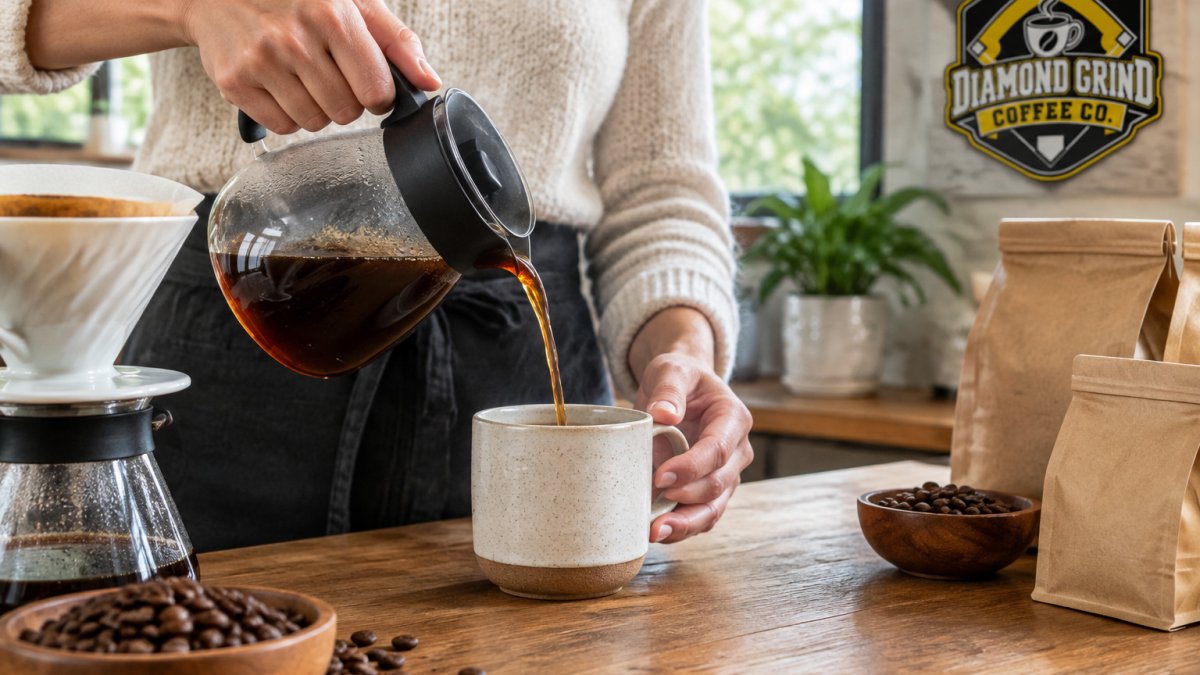
!Close-up of a person's hands pouring freshly brewed coffee from a pour-over into a ceramic mug on a wooden kitchen counter, with small bags of roasted beans nearby
How Growing Region, Altitude and Processing Shape the Cup
Three factors do most of the work. Growing region and climate set the baseline sweetness and acidity. Altitude affects how slowly the cherry ripens, which influences density and complexity. Processing, meaning whether the cherry is washed, dried whole or pulped and dried, adds another layer, often bringing out fruit or wine-like notes in natural-process coffees.
Our Ethiopia Natural, for example, is full natural processed and dried on raised beds, which is part of why its listing describes fruity and caramel notes. Browse our single origin coffees to compare how different regions and processes taste side by side.
Traceability, Farms and Ethical Sourcing: What to Verify
Traceability is the clearest sign that a single origin label means something. But "traceable" is used loosely, so the useful question is how many steps of the supply chain the seller can actually document. A meaningful label lets you follow the coffee from a specific producer or producer group to the lot you bought, not just to a country.
Reading origin labels at four levels of precision
Origin labels fall into a rough hierarchy, and knowing where a bag sits tells you how much traceability to expect:
- Country-level: "Colombia" or "Ethiopia." The broadest label. Useful for flavor expectations, weak for traceability because beans from many farms and regions can be combined.
- Region-level: A named growing area such as Yirgacheffe, Huila, or Nyeri. Narrower, but still often a blend of many smallholders within that area.
- Cooperative or washing station: A named producer group or processing site. This is where traceability becomes meaningful, because a specific group of farmers and a specific processing operation are identified.
- Single farm or estate: The most precise label. One producer, often one lot, with farm name and sometimes altitude and harvest year.
A bag that names only a country is not dishonest, but it is not the same product as a bag that names a farm and lot. Compare labels at the same level before comparing prices.
What meaningful traceability looks like on a product page
Specific, checkable details are worth more than broad marketing language. A seller with real traceability can usually tell you:
- The producer, farm, estate, or cooperative name
- The region and, often, the altitude range
- The processing method (washed, natural, honey, and so on)
- The harvest or crop year
- The lot or producer group, especially for cooperative coffees
If a product page lists only "100% Arabica, ethically sourced" with no producer or region, treat the traceability claim as unverified. That does not mean the coffee is poorly sourced; it means you cannot confirm the claim from the information given.
How to verify ethical and sourcing claims
Ethical claims deserve the same scrutiny as origin claims. Ask which certifications the seller holds and what each one actually verifies, because certifications differ in scope.
For claims without a certification, look for specifics you can check: named producer relationships, published sourcing reports, lot-level information, or direct-trade language that identifies the producer. Vague phrases such as "ethically sourced" or "farm-direct" tell you little on their own because they have no agreed definition.
Watch out: a farm name alone does not prove ethical sourcing, it proves traceability. The two are related but separate claims, and a seller can be fully traceable while still declining to disclose pricing or labor practices.
A quick verification checklist
Before you buy, confirm four things: the label names a producer or producer group, the region and processing method are stated, a harvest or crop year appears, and any ethical claim is either certified or backed by named producer details. If two of those four are missing, the bag is probably a country-level or region-level coffee being marketed with more precision than the label supports.
Our own listings aim to state region, process, and roast level so you can compare like with like. Browse our single origin coffees and check how much of the checklist each bag satisfies.
Ethiopian Single Origin Coffee as a Starting Point
Ethiopian coffees are a good first single origin for many buyers because their flavor profiles are distinctive and easy to notice. Our Ethiopia Natural is a medium-light roast with milk chocolate, fruity and caramel notes, priced at $24.99.

Why Single Origin Coffee Costs More
Single origin coffee often costs more because it is sourced from a smaller lot and handled separately from the blend pool. Pricing reflects those steps, so compare bags on the traceability and freshness they offer, not only the price per ounce.
Freshness, Roast Dates and Brewing by Roast Level
Freshness matters more than most buyers expect, and it is one of the few quality signals you can check before spending money. Coffee is a agricultural product that peaks, then declines. Roasted beans release carbon dioxide for several days after roasting, then begin to lose aromatic compounds. Ground coffee stales far faster than whole bean because the increased surface area speeds up that loss.
How to read a roast date
A roast date tells you when the beans were roasted; a "best by" date tells you almost nothing, because it is set by the seller and can be months after roasting. Look for a printed roast date on the bag. As a general guide, whole-bean coffee tends to be at its best for a few weeks after roasting, with the window varying by roast level and storage.
If a bag shows only a best-by date, ask the seller for the roast date. A seller who roasts to order can usually tell you. Our coffee is roasted to order and shipped the same day it is roasted.
Storage that preserves origin character
Store whole beans in an airtight container away from light, heat, and moisture. A cool cupboard is better than a refrigerator for daily-use beans, because repeated temperature swings and condensation degrade quality. Buy in amounts you will finish within a few weeks rather than stocking up, and grind just before brewing when you can. Freezing works for longer storage if the beans are sealed well, but thaw them fully before grinding to avoid condensation.
Brewing by roast level: starting points
Roast level changes how much origin character reaches the cup. Lighter roasts preserve more acidity and origin-specific flavor; darker roasts add body and roasted flavors that can mask delicate notes. Match the roast to the brewer, then adjust grind and ratio to taste.
- Light roasts: Pour-over and other filter methods suit light roasts because they let acidity and aromatics come through. A common starting point is a medium-fine grind, a ratio near 1:16 coffee to water by weight, and water just off the boil.
- Medium roasts: Work well across drip, pour-over, and espresso. For espresso, start with a fine grind and a ratio near 1:2 coffee to yield by weight, then adjust.
- Dark roasts: French press and espresso suit darker roasts, which extract more readily. Use slightly cooler water and a slightly coarser grind to avoid bitterness.
How grind, water, and extraction reveal or hide origin flavor
Under-extraction, too coarse a grind, too short a brew, or water that is too cool, tends to produce sour, thin, or salty cups that hide sweetness and origin character.
Watch out: a bag past its peak can taste flat no matter how carefully you brew, so check the roast date before you troubleshoot your recipe.
Our Ethiopia Natural is a medium-light roast, so it sits between the light and medium guidance above. Browse our single origin coffees to compare roast levels before you buy.
Roast level and brew method together shape how much origin character reaches the cup, so the table below gives starting points from the article.
| Roast level | Brewing method | Starting point |
|---|---|---|
| Light | Pour-over or filter | Medium-fine grind, about 1:16 by weight |
| Medium | Drip, pour-over or espresso | Fine grind for espresso, about 1:2 by weight |
| Dark | French press or espresso | Slightly coarser grind, slightly cooler water |
Choose Your First Single Origin Bag From a Sample Pack
If you are unsure which origin to start with, a sample pack is the simplest way to decide. Our Single Origin Favorites Sample Pack includes six 2oz packs for $24.99, so you can taste several coffees before buying a full bag. Once you know which profile you prefer, shop our full single origin collection to pick your bag.
Ready to taste the difference? Diamond Grind Coffee roasts small batches to order, so your beans arrive fresh. Start with a sample pack and find the origin that suits your cup. SHOP FRESH.
Frequently Asked Questions
Is single origin coffee healthier?
Single origin coffee is not inherently healthier than a blend. Both are roasted coffee beans with similar caffeine and compound profiles, and the origin mainly changes flavor, not nutrition. Any health difference comes from brewing choices such as added sugar, cream, or filtered versus unfiltered methods. If you have a specific health concern, such as caffeine sensitivity or acid reflux, check with a doctor rather than choosing a bean by origin alone. Origin is a flavor decision first.
Why is single origin coffee more expensive?
Single origin coffee usually costs more because it comes from a single farm, cooperative or region, so it is produced in smaller lots. Growers often receive higher payments for lots with distinct quality, and roasters buy less volume, which raises per-pound costs. Small-batch roasting and traceability records add to the price. Diamond Grind Coffee's Single Origin Favorites Sample Pack lets you compare six origins in 2 oz packs for $24.99 before committing to a full bag.
Which is better, a coffee blend or single origin?
Neither is better across the board. Blends are designed for consistency, balancing several origins so the cup tastes similar from batch to batch. Single origin coffee shows the distinct character of one place, with clearer fruit, floral or chocolate notes, but it can vary more between harvests. Choose a blend for a dependable everyday cup and single origin when you want to taste where the beans were grown.