 ultimate-guide
What Is the Best Grind Size for Espresso Machines?
Last Updated: October 25, 2026
Quick Summary
The best grind size for espresso machines is a fine grind with the texture of powdered sugar, just short of flour, that lets a shot run in roughly 25 to 30 seconds at a normal dose. Grinder setting numbers are arbitrary per model, so dial in by texture, dose, and time instead.
- Pinch the grounds: espresso grind should feel like powdered sugar with a few tiny grains, not fine sand or flour.
- Start with an 18 gram dose and about 36 grams out, a 1:2 brew ratio, then adjust grind only.
- Begin two or three settings coarser than you think you need, since going finer is easier than fixing a choked shot.
- If a shot runs fast, grind finer; if it chokes, go coarser, changing one or two clicks at a time.
- Expect to spend a full bag of beans learning a new grinder, and expect the setting to drift as beans age.
Table of Contents
- The Best Espresso Grind Size Starts With Texture, Not Numbers
- Your Espresso Grind Size Chart (and Why the Numbers Do Not Transfer)
- How to Dial In Espresso: A Repeatable Dose, Yield, and Time Workflow
- When Your Espresso Grind Is Too Fine (and How to Tell)
- Espresso Extraction Time: The 25-30 Second Range and What It Really Tells You
- Beans, Roast Level, and Freshness: Why the Same Setting Drifts
- Order Espresso-Ground Coffee From Diamond Grind Coffee
- Frequently Asked Questions
The Best Espresso Grind Size Starts With Texture, Not Numbers
The best grind size for espresso machines is a fine grind with the texture of powdered sugar, just short of flour, that lets a shot run in roughly 25 to 30 seconds at a normal dose.
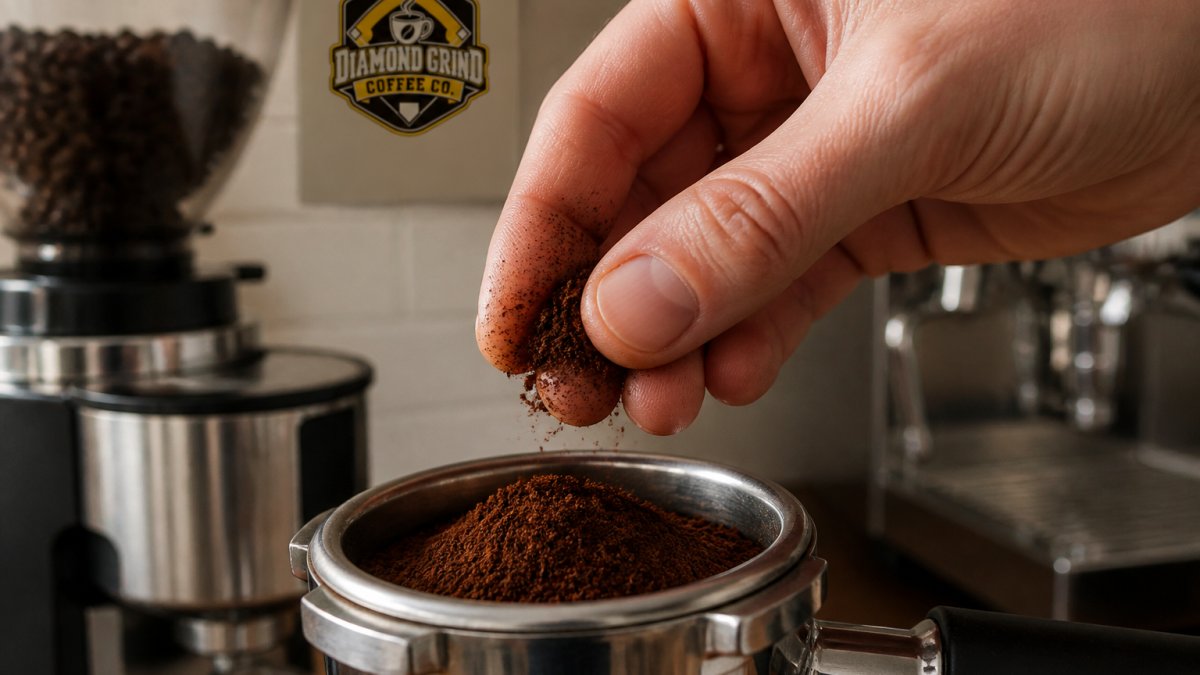
Espresso grind size is the average particle size of ground coffee, and it decides how fast water moves through the puck. Too coarse and water races through, leaving sour, thin shots.
What Fine Actually Means Between Your Fingers
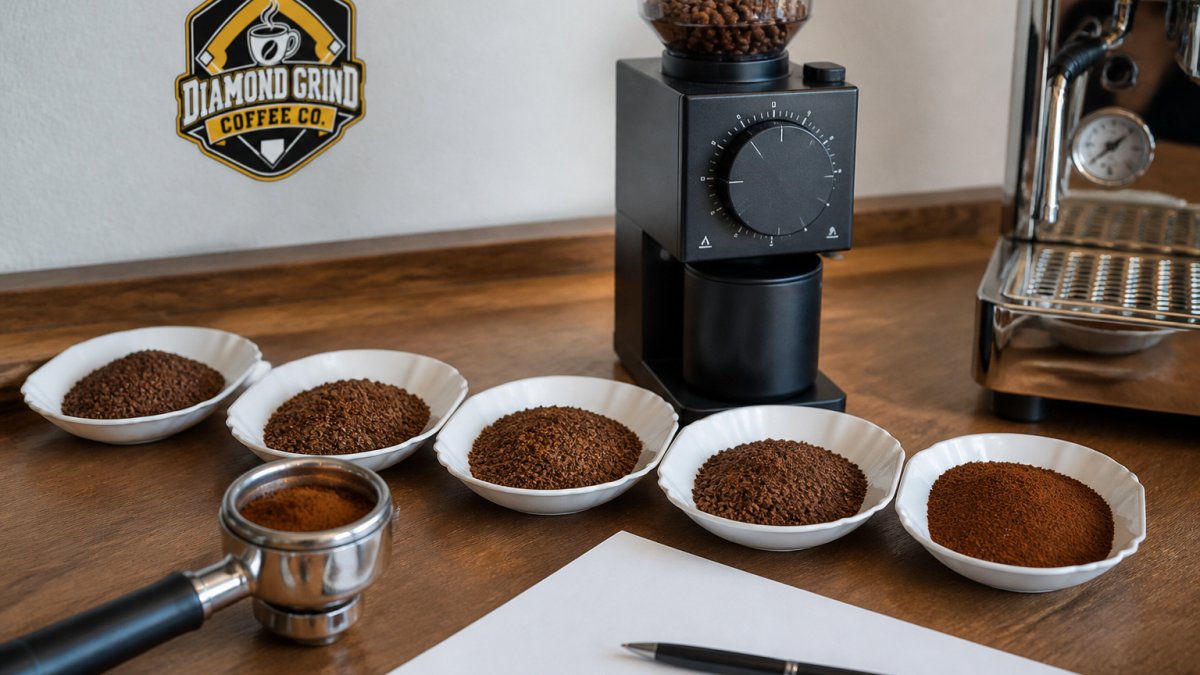
Pinch a little ground coffee and rub it between thumb and forefinger. Espresso grind should feel slightly gritty but mostly smooth, like powdered sugar with a few tiny grains left in it. If it feels like fine sand, it is too coarse. If it smears and clumps like flour, you have gone too fine. This tactile check is the most reliable starting point you have, and it costs nothing.
Your Espresso Grind Size Chart (and Why the Numbers Do Not Transfer)
No universal espresso grind size chart exists, because grind setting numbers are arbitrary per grinder model. A "4" on one burr grinder is a "12" on another.
| Grind Category | Texture Reference | Typical Use | Starting Point For |
|---|---|---|---|
| Coarse | Sea salt | French press, cold brew | Not espresso |
| Medium | Table salt | Drip, pour over | Not espresso |
| Medium-fine | Fine sand | AeroPress, moka pot | Pressurized baskets |
| Fine | Powdered sugar | Espresso | Non-pressurized baskets |
| Extra fine | Flour | Turkish, some espresso | Only if shots run fast |
The chart tells you where to begin. If you want a broader walkthrough of matching grind to brewer, our guide on how to grind coffee beans for a better cup covers the full range.
Pressurized vs. Non-Pressurized Baskets Change the Target
Pressurized baskets, the kind with a single small hole and a spring valve, create their own back pressure. They tolerate a coarser, medium-fine grind because the basket, not the coffee, does much of the work. Non-pressurized baskets rely entirely on the puck, so they demand a genuinely fine grind and punish inconsistency. If your machine came with a pressurized basket and you switch to a standard one, expect to grind noticeably finer and to need a proper burr grinder.
How to Dial In Espresso: A Repeatable Dose, Yield, and Time Workflow
Dialing in espresso means fixing your dose and yield, then adjusting grind size until the shot finishes in your target time window. Change one variable at a time. This is the workflow we recommend to anyone starting fresh, and it is built around three numbers you can actually measure: dose in grams, yield in grams, and shot time in seconds.
The Three Numbers That Matter
Before you touch the grinder, lock these three variables so you have a stable baseline:
- Dose. Weigh 18 grams into the portafilter for a standard double basket. Use a scale that reads to 0.1 grams; eyeballing the basket fill is not repeatable.
- Yield. Aim for about 36 grams of liquid espresso out, a 1:2 brew ratio. A 1:2 ratio is a common starting point for medium and dark roasts; lighter roasts often benefit from a slightly longer ratio such as 1:2.5, but start at 1:2 and adjust after you have a stable shot.
- Time. Target roughly 25 to 30 seconds from first drip to the end of the shot. Treat this as a reference window, not a rule, because a larger dose or longer yield naturally takes more time.
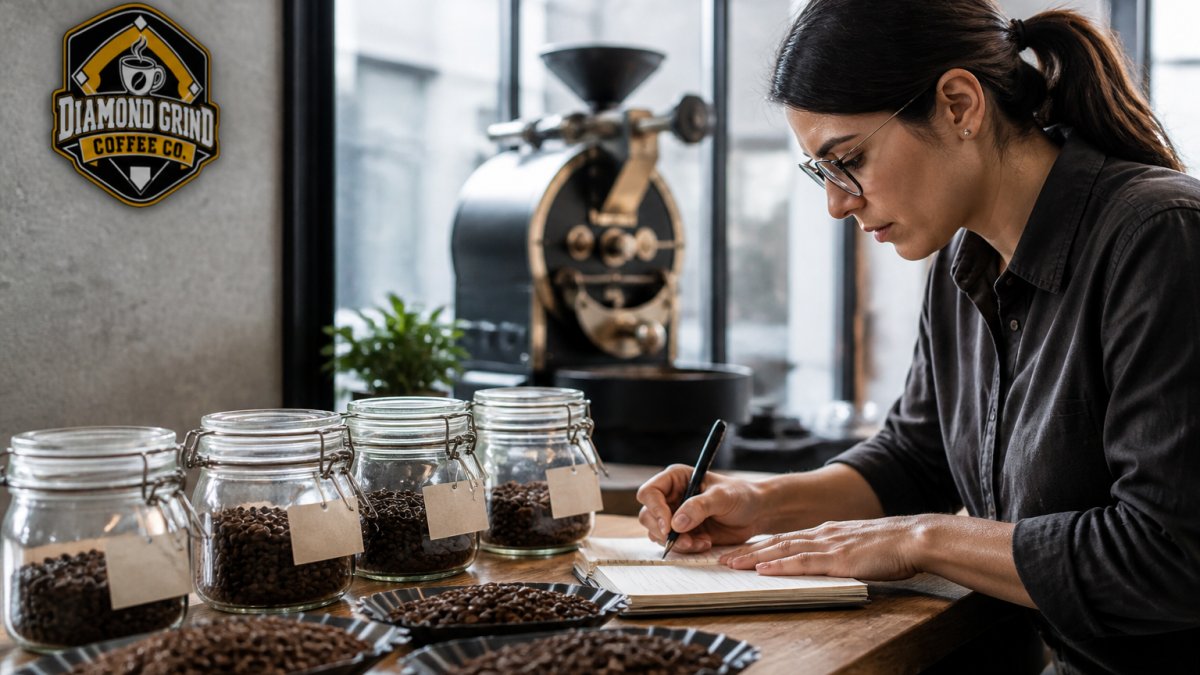
Write these three numbers down for every shot. A simple notebook or a notes app is enough. Without a record, you cannot tell whether a change helped or hurt.
A Repeatable Dialing-In Workflow
- Lock the dose. Weigh 18 grams into the portafilter for a standard double basket.
- Lock the yield. Aim for about 36 grams of liquid espresso out, a 1:2 brew ratio.
- Set a coarse starting point. Begin medium-fine and work finer. If you have never dialed in this grinder, start two or three settings coarser than you think you need; it is easier to go finer than to recover from a choked shot.
- Pull a shot and time it. Note total shot time from first drip to cutoff, plus the yield on the scale.
- Adjust grind only. If it ran fast, go finer. If it choked, go coarser. Change one or two clicks on a stepped grinder or a narrow turn on a stepless one.
- Purge and repeat. Purge a few grams of coffee through the grinder so the next shot uses only fresh grounds, then pull another shot and record the time and yield.
- Repeat until the time lands in range, then taste and fine-tune. Two or three iterations usually get you close.
A common mistake is changing dose and grind at the same time. You will never learn which change caused the result. Keep dose and yield fixed for at least three shots before touching anything else.
Why Grinder Settings Do Not Transfer
A setting of "4" on one burr grinder is a "12" on another, and sometimes a "4" on the same model after a burr swap or recalibration. Grind setting numbers are arbitrary per grinder model because burr geometry, adjustment range, and calibration differ.
When you change beans, expect the setting to drift. A new bag of the same coffee may need a click finer or coarser than the last bag.
Step-by-Step: Adjusting Grind Size Based on Shot Results
Adjust in small increments, one or two clicks on a stepped grinder or a narrow turn on a stepless one. After each change, purge a few grams of coffee through the grinder so the next shot uses only fresh grounds. Pull another shot, record the time and yield, and taste.
If you want a broader walkthrough of matching grind to brewer, our guide on how to grind coffee beans for a better cup covers the full range.
When Your Espresso Grind Is Too Fine (and How to Tell)
An espresso grind that is too fine shows up as a shot that barely drips, runs well past 30 seconds, and tastes bitter or drying. You may also see channeling, where water punches through weak spots in the puck and leaves pale, uneven extraction.
Watch out: grinding so fine that the machine chokes can stress a cheap pump over time. If a shot produces nothing after several seconds, stop and coarsen before trying again.
Espresso Extraction Time: The 25-30 Second Range and What It Really Tells You
Espresso extraction time is the total duration of a shot, and 25 to 30 seconds is a useful reference window, not a rule. That range assumes a standard dose and yield.
Shot time tells you how fast water moved through the puck, which is a direct read on grind and puck prep. Tamping and distribution matter here too. Even, level tamping prevents channeling and keeps flow predictable.
Beans, Roast Level, and Freshness: Why the Same Setting Drifts
The same grinder setting will produce different shots as your beans age, because freshness changes how coffee grinds and how it releases gas. Very fresh beans degas heavily and can cause uneven flow, so many baristas rest beans for a few days after roast. Darker roasts are more brittle and often need a slightly coarser setting than light roasts at the same dose.
This is exactly why we roast to order at Diamond Grind Coffee: you know the roast date, so you can plan around it instead of guessing. If you want help judging freshness, our guide on how to tell if coffee is fresh walks through what to look for. Choosing beans that suit espresso also matters, and our picks for the best espresso beans for home brewing explain which roasts dial in most forgivingly.
Order Espresso-Ground Coffee From Diamond Grind Coffee
If you would rather skip the grinder learning curve, order your coffee ground for espresso and start from a known baseline. Our 6 Bean Blend is a dark roast house blend built for espresso, and our African Espresso brings a medium-dark blend of Kenyan, Tanzanian, and Ethiopian coffees for a brighter shot. You can also shop African Espresso directly and see the current roast.

Frequently Asked Questions
What grind size should I use for an espresso machine?
Start with a fine espresso grind that clumps slightly when pinched and feels like powdered sugar, then adjust from there. There is no universal number because every grinder's settings are different. Pull a shot with a fixed dose of 18 grams, aim for roughly 36 grams out in 25 to 30 seconds, and move the grind finer if it runs fast or coarser if it runs slow. Your espresso grind is correct when the shot tastes balanced, not when the dial matches someone else's recipe.
How do I know if my espresso grind is too fine?
An espresso grind too fine shows up as a shot that drips slowly, takes well over 30 seconds to reach your target yield, and tastes bitter or dry. You may also see channeling, where liquid finds a path through the puck and sprays unevenly. If the pump sounds strained and almost nothing comes out, stop the shot and back the grind off two or three steps coarser. Fine is the goal, but past a point it blocks water instead of slowing it evenly.
Does espresso extraction time really need to be 25 to 30 seconds?
That range is a useful starting point, not a rule. Espresso extraction time is a diagnostic: it tells you whether the grind and dose are letting water through at a sensible rate. A 20-second shot that tastes sweet and balanced is fine. A 35-second shot that tastes bitter usually means the grind is too fine. Use time to spot changes, then let taste make the final call on whether to adjust finer or coarser.
Why do grinder settings from a recipe or video not work on my grinder?
Numbered settings are relative to each grinder model, and often to each individual unit. A setting of 4 on one burr grinder can be much finer or coarser than a 4 on another. Calibration also shifts as burrs wear in. Treat any shared setting as a starting point only, then dial in espresso on your own machine using dose, yield, and shot time as your reference points instead of the number on the dial.
Does the grind size change with different coffee beans or roast levels?
Yes. Darker roasts are more porous and usually need a slightly coarser grind, while lighter roasts often need a finer setting to extract fully. Freshness matters too: beans a few days off roast release gas that resists water flow, so you may grind finer early and coarser as the bag ages. Expect to make small adjustments every few days, and re-dial whenever you open a new bag of coffee beans.
Should I buy pre-ground espresso or grind whole bean at home?
Whole bean ground just before brewing gives you the most control, because you can adjust the grind setting shot by shot. Pre-ground espresso from a roaster like Diamond Grind Coffee works well if you do not own a burr grinder, but you cannot fine-tune it. If you order pre-ground, ask for an espresso grind and use it within a couple of weeks for the best flavor and crema.
Getting espresso right is less about finding a magic number and more about building a repeatable routine: fixed dose, fixed yield, small grind adjustments, and honest tasting. Diamond Grind Coffee makes the bean side of that equation easier with small-batch coffee roasted to order, same-day shipping, and grind options that include espresso so you start close to the target. Get started with Diamond Grind Coffee and pull a shot you can actually repeat tomorrow.