 how-to
How to Store Coffee Beans for Maximum Freshness
Table of Contents
- Why Freshness Matters: Understanding Coffee Degradation
- Best Coffee Storage Containers: What Actually Works
- Step 1: Choose Your Storage Location
- Step 2: Control Temperature and Humidity
- Step 3: How to Tell if Coffee is Fresh
- Should You Freeze Coffee Beans? The Real Answer
- Grinding Beans Immediately Before Brewing
- Common Coffee Storage Myths Debunked
- Frequently Asked Questions
Last Updated: September 21, 2026
Why Freshness Matters: Understanding Coffee Degradation
Fresh coffee tastes bold and vibrant. Stale coffee tastes flat and bitter. The difference comes down to what happens inside the bean after roasting.
When coffee is roasted, it releases gases and develops its flavor compounds. These volatile compounds give coffee its aroma and taste. Over time, oxygen breaks down these compounds through oxidation. The beans also absorb moisture from the air, which dulls the flavor profile even more.
This degradation happens fast. Most coffee loses its peak freshness within 2-4 weeks of roasting. After that window closes, the flavor fades noticeably. This is why how to store coffee beans for maximum freshness matters so much. Proper storage slows oxidation and keeps moisture out, extending that peak window.
At Diamond Grind Coffee, we roast your order the same day it ships. This means you get beans at their absolute freshest. But once they arrive at your door, storage becomes your responsibility. The right container and location can keep your coffee tasting excellent for weeks longer than careless storage would allow.
Best Coffee Storage Containers: What Actually Works
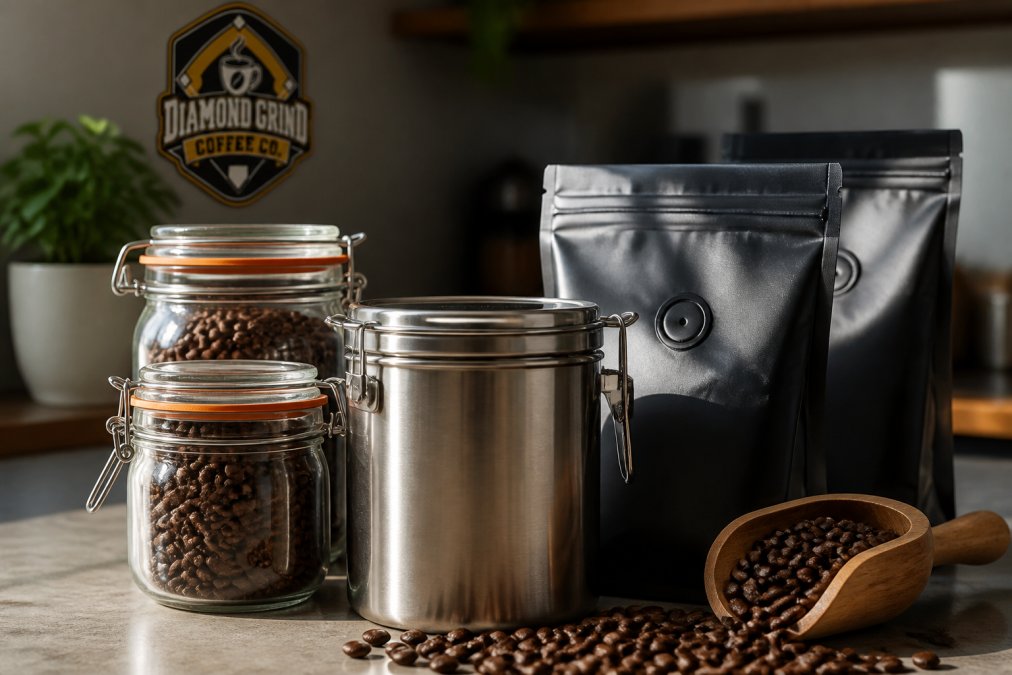
Not all containers protect coffee equally. The best ones block light, seal out air, and resist moisture. Let's break down what actually works.
Airtight Containers with One-Way Valves
Coffee naturally releases CO2 after roasting, and trapping that gas would create pressure and affect flavor. A one-way valve solves this problem.
Look for bags or containers with a clearly marked one-way valve. When you squeeze the bag, air should only escape one direction.
Glass jars with airtight rubber seals work well too, but they lack the one-way valve. The glass is opaque if you choose dark-colored jars, which protects against light exposure.
Stainless steel canisters block light completely and seal airtight.
Opaque vs. Clear: Why Light Exposure Matters
Light breaks down coffee's flavor compounds through a process similar to oxidation. UV rays from sunlight are especially damaging. Clear containers expose your coffee to this damage every day.
Choose opaque containers whenever possible. Dark glass, stainless steel, and ceramic all work well. If you use a clear container, store it in a dark cupboard or pantry. Never leave coffee on the counter in a clear jar, even if it looks nice.
If you transfer beans to a different container, choose one that blocks light completely.
Step 1: Choose Your Storage Location
Your storage location matters as much as your container. The best spot is cool, dark, and dry. A kitchen pantry is ideal. A cupboard away from the stove is perfect. The freezer is not.
Avoid these locations:
- Above or next to the stove (heat damages beans)
- On the counter in sunlight (light breaks down flavor)
- Near the refrigerator (temperature swings cause condensation)
- In the freezer (moisture and freezer burn ruin beans)
- In the fridge (condensation forms when you open it)
Temperature fluctuations are a real problem. Every time you open a cupboard, warm air enters. If that cupboard is cool, condensation can form on the beans. This moisture degrades flavor quickly. A stable, cool environment prevents this.
If your kitchen runs hot, find the coolest cupboard available. Even a slight difference matters for how to store coffee beans for maximum freshness.
Step 2: Control Temperature and Humidity
Humidity is coffee's enemy. Beans are porous and absorb moisture from the air. Once moisture gets inside, it triggers the staling process much faster. High humidity can cut your coffee's freshness window in half.
Monitor the humidity in your storage area if possible. If you live in a humid climate, this becomes even more critical. A one-way valve bag helps, but it's not foolproof against sustained high humidity.
Temperature fluctuations accelerate flavor degradation. Keep your storage spot as stable as possible.
If you live somewhere very humid or hot, consider a dedicated storage solution.
Step 3: How to Tell if Coffee is Fresh
Freshness has visual, aromatic, and taste signals. Learn to spot them so you know when your coffee is still at its peak.
Best Sellers Sample Pack: 6Bean →
Fresh coffee beans look shiny and have visible oils on the surface. Stale beans look dull and dry. This is especially noticeable with darker roasts.
The aroma is the easiest indicator. Open your bag and smell deeply. Fresh coffee smells bold and complex. You should smell the roast character, whether that's chocolate, fruit, nuts, or caramel. Stale coffee smells flat and one-dimensional. If the aroma is weak or musty, the beans are past their peak.
When you grind fresh beans, the aroma intensifies. Stale beans release less aroma when ground. This is because those volatile compounds have already escaped or degraded.
The taste test is final confirmation. Fresh coffee tastes bright and complex. Stale coffee tastes thin and bitter. If your usual brew suddenly tastes worse without any change in your brewing method, your beans are aging. This is why how to tell if coffee is fresh matters before you brew.
| Freshness Indicator | Fresh Beans | Stale Beans |
|---|---|---|
| Appearance | Shiny, oily surface | Dull, dry look |
| Aroma | Bold, complex scent | Flat, weak smell |
| When ground | Strong aroma release | Minimal aroma |
| Taste | Bright, complex flavor | Thin, bitter taste |
| Timeline | Within 2-4 weeks of roast | Beyond 4 weeks of roast |
Should You Freeze Coffee Beans? The Real Answer
Freezing coffee can work, but only under specific conditions.
The problem is condensation. When you remove frozen beans from the freezer, they warm up. Moisture in the air condenses on the cold beans, just like moisture forms on a cold glass of water. This moisture damages the beans' flavor compounds.
Freezing works only if you follow strict rules:
- Use airtight, opaque containers (not bags)
- Store in the freezer at 0°F or below
- Remove only what you need for one brewing session
- Never thaw and refreeze the same beans
- Let frozen beans come to room temperature before opening the container
Even following these rules, freezing is not ideal. It's a last resort for beans you won't use for months.
For most people, a cool, dark pantry beats the freezer every time. You avoid condensation risk, and your beans stay fresher longer.
Grinding Beans Immediately Before Brewing
Whole beans stay fresh longer than ground coffee. The moment you grind, you expose far more surface area to oxygen. Ground coffee stales in days. Whole beans stay fresh for weeks.
This is why how to store coffee beans for maximum freshness only works if you grind just before brewing. Grinding releases the volatile compounds that make coffee taste good. If you grind ahead of time, those compounds escape into the air or oxidize before you brew.
The best practice is simple: buy whole beans, store them properly, and grind only what you need for each brew. The flavor difference is dramatic compared to pre-ground coffee.
If you can't grind at home, ask your roaster to grind to your exact specification. Diamond Grind Coffee offers customizable grind options from whole bean to espresso, standard, and coarse. This means you can order beans already ground to match your brewing method perfectly. Grind your beans the day they arrive, or grind them fresh each morning. Either way, you get better flavor than buying pre-ground weeks before.
Common Coffee Storage Myths Debunked
Several myths about coffee storage persist, and they cost you flavor.
Myth 1: Coffee should be stored in the fridge. False. The fridge is humid and has temperature swings every time you open it. Condensation forms on beans, which accelerates staling. A cool pantry is always better than a fridge.
Myth 2: Freezing coffee extends freshness indefinitely. False. Freezing can work short-term if done perfectly, but most people thaw and refreeze, which causes condensation damage. Freezing is a last resort, not a storage solution.
Myth 3: Coffee lasts for months after roasting. False. Peak freshness is 2-4 weeks. Coffee is still drinkable after that, but flavor fades noticeably. Buying smaller quantities more often beats buying in bulk.
Myth 4: Clear containers are fine if you keep them in a cupboard. Partially true, but opaque is always better.
Frequently Asked Questions
How do I know if my coffee beans are still fresh?
Fresh coffee beans release a visible bloom of carbon dioxide when hot water first contacts them during brewing. Check the roast date on the bag, peak freshness typically occurs within 2-4 weeks of roasting. Look for beans with an oily sheen (especially for dark roasts) and smell for a strong, vibrant aroma. Stale beans smell flat or cardboard-like. If your beans are more than 4 months old or lack aroma, they've lost significant flavor compounds through oxidation and degassing.
Is it better to store coffee beans in glass or stainless steel containers?
Both work well. Choose an opaque container with an airtight seal and ideally a one-way valve to release carbon dioxide without allowing oxygen in. Glass is excellent if it's completely opaque; transparent or translucent containers expose beans to light degradation regardless of other factors.
Should I freeze my coffee beans to extend shelf life?
Freezing can extend shelf life but introduces condensation risk. If you freeze, use an airtight, moisture-proof container and allow beans to reach room temperature before opening to prevent condensation. For most home brewers, proper pantry storage in an airtight container away from heat and light preserves freshness better than freezing. Freezing works only if you commit to it long-term and never thaw-and-refreeze.
Can I store coffee in a regular Ziploc bag?
Regular Ziploc bags are not ideal because they lack an oxygen barrier and allow gradual air infiltration. They also lack a one-way valve to release carbon dioxide from freshly roasted beans. If you must use a bag, squeeze out as much air as possible and store it in an opaque, airtight container for added protection.