 Comparison
Pour Over vs Immersion Brewing for Beginners
Last Updated: November 14, 2026
Quick Summary
The core difference in pour over vs immersion is how water meets coffee: immersion lets grounds soak in still water for about 4 minutes, while pour over runs water through the bed once in 3 to 4 minutes. Immersion gives a heavier, forgiving cup, while pour over gives a cleaner cup that rewards technique.
- Immersion uses a coarse grind like sea salt; pour over uses a medium grind like table salt.
- Both methods start with 20 g coffee to 340 g water, a 1:17 ratio.
- Heat water to 200°F to 205°F, just off a boil, for both methods.
- A stalled pour over drawdown usually means the grind is too fine.
- A 34-ounce French press suits one or two people; a 12-ounce press suits a single mug.
Table of Contents
- Pour Over vs Immersion Brewing: The Core Difference
- Percolation vs Immersion Coffee: Side-by-Side Comparison
- Flavor, Body, and Clarity: How the Cup Profiles Differ
- Grind Size, Brew Time, and Extraction Control
- Pour Over Coffee for Beginners: What to Expect
- Choosing the Best Immersion Coffee Brewer for Your Kitchen
- Which Method Fits You? A Beginner Decision Guide
- Pick Your Beans and Start Brewing
- Frequently Asked Questions
Pour Over vs Immersion Brewing: The Core Difference
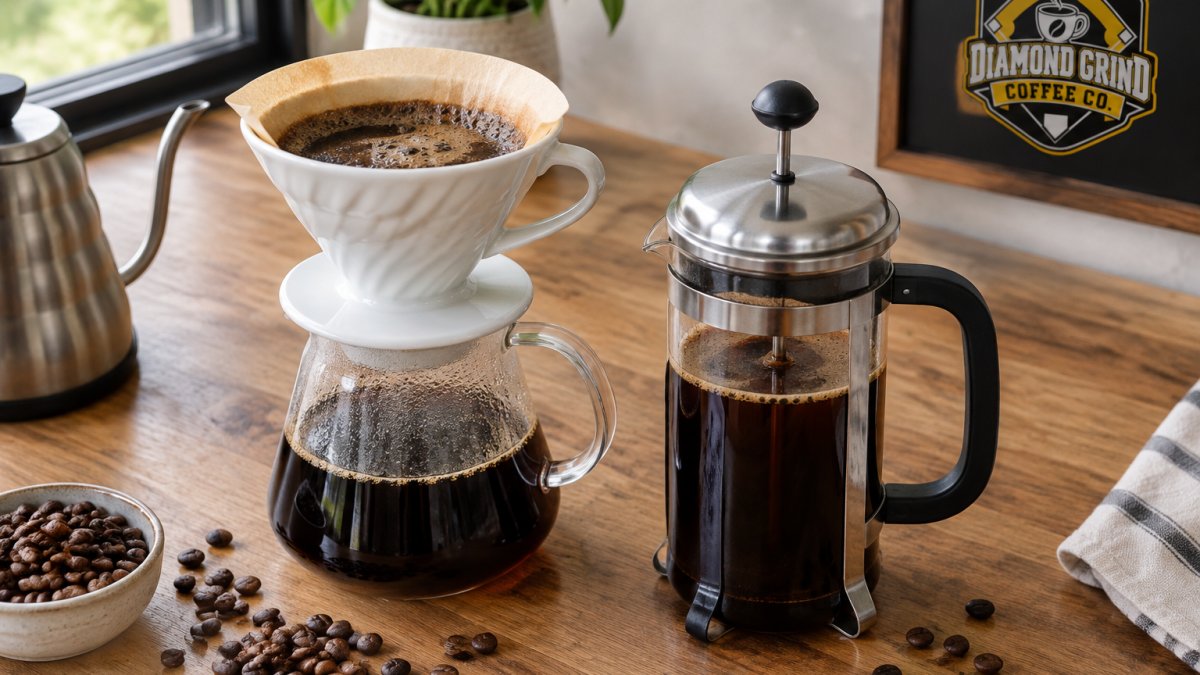
The core difference in pour over vs immersion brewing comes down to how water meets coffee: immersion lets grounds soak in still water, while pour over runs water through the bed once.
What Immersion Brewing Actually Does
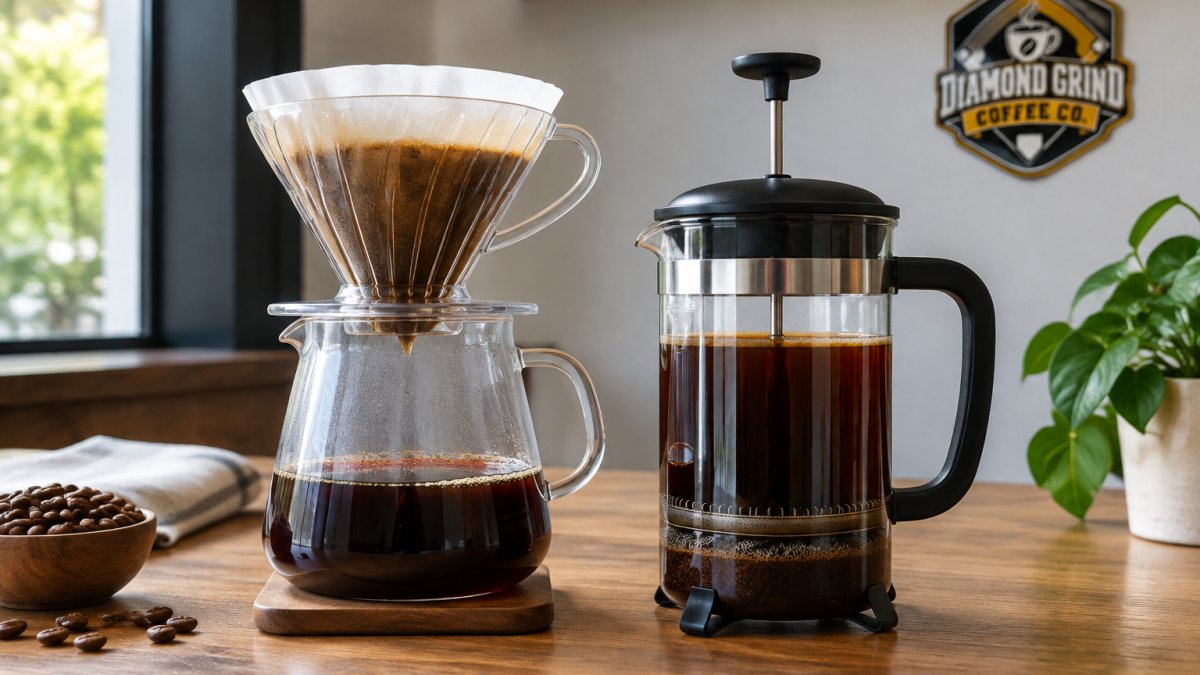
Immersion brewing is a method where coffee grounds steep fully submerged in hot water for a set time, then get separated from the liquid. A French press is the classic example. Extraction happens evenly across every particle, and the metal mesh filter lets oils and fine sediment through to the cup. The result is a heavier, rounder texture, and immersion is forgiving: if you lose track of the clock by thirty seconds, the cup usually still tastes fine.
What Percolation and Pour Over Brewing Do
Percolation is brewing where water passes through a bed of coffee grounds once, under gravity, rather than soaking them. Pour over is the manual version: you pour hot water in stages over grounds in a paper filter, and it drips through into a carafe below. Paper filters trap oils and sediment, so the cup reads cleaner and lighter, but pour over rewards attention: a sloppy pour shows up in the taste.
Percolation vs Immersion Coffee: Side-by-Side Comparison
The percolation vs immersion coffee comparison is where beginners get the clearest picture. Here is how the two stack up on the factors that affect your mornings.
| Factor | Immersion (French Press) | Pour Over |
|---|---|---|
| Equipment needed | Press, kettle, grinder | Dripper, paper filters, carafe, gooseneck kettle, scale |
| Grind size | Coarse | Medium |
| Brew time | 4 minutes, hands-off | 3-4 minutes, active pouring |
| Body and mouthfeel | Heavy, rich, oily | Light, clean, tea-like |
| Clarity | Low, some sediment | High |
| Control | Forgiving, hard to ruin | Precise, rewards technique |
| Cleanup | Rinse the mesh, quick | Discard wet filter, rinse dripper |
| Cost to start | Lower | Slightly higher |
Best for pour over: tinkerers, single-cup drinkers, and anyone chasing the bright, layered flavors of a light roast.
** Skip pour over if: you want a set-and-walk-away brew or you are routinely rushed out the door.
Flavor, Body, and Clarity: How the Cup Profiles Differ
Flavor differences come from two things: filter material and contact style. Immersion with a metal filter leaves coffee oils in the cup, and those oils carry weight and aroma, which is why a French press cup feels almost creamy and the finish lingers. Pour over with a paper filter strips most oils and all sediment, lifting the high notes: fruit, floral, citrus, and tea-like aromatics.
A medium roast like our Brazil Santos carries its cocoa notes, with an elegant, smooth cup profile. A medium-light roast such as Ethiopia Natural has a milk chocolate, fruity, caramel profile.
Grind Size, Brew Time, and Extraction Control
Grind size and brew time are the two dials you turn to control extraction, and each method asks for different settings. The table below gives starting points, not laws; adjust from there one variable at a time.
| Setting | Immersion (French Press) | Pour Over |
|---|---|---|
| Grind size | Coarse, like sea salt | Medium, like table salt |
| Dose for one mug | 20 g coffee to 340 g water (1:17) | 20 g coffee to 340 g water (1:17) |
| Water temperature | 200°F to 205°F | 200°F to 205°F |
| Total contact time | About 4 minutes, then plunge | 3 to 4 minutes including drawdown |
| Agitation | One stir at the start, then leave it | Gentle circles during each pour |
| What tells you it is off | Bitter = too fine or steeped too long | Slow drawdown = too fine; fast = too coarse |
Immersion uses a coarse grind because the grounds steep for minutes and a fine grind would over-extract into bitterness. In pour over, drawdown speed tells you whether your grind is right: a slow, stalling drawdown means too fine, and a brew that drains in under 2:30 usually means too coarse.
A controlled, like-for-like comparison
To understand which differences come from the method rather than the bean, brew the same coffee, the same 20-gram dose, and the same 340 grams of water both ways on the same morning. Taste side by side and score four things: aroma, acidity, body, and finish.
Water temperature matters in both: aim just off a boil, and stay consistent. For a deeper walkthrough on dialing in a dripper, our step-by-step grind size guide for pour over covers the adjustments in order. For matching grind to brewer, see how to grind coffee beans for a better cup.
Pour Over Coffee for Beginners: What to Expect
Pour over coffee for beginners is simpler than it looks once you have a repeatable recipe and a matched immersion recipe to compare it against. Expect your first few cups to be uneven, and expect the fix to be obvious once you taste them.
Matched starter recipes, same coffee both ways
Use 20 grams of coffee and 340 grams of water for both methods, a 1:17 ratio. Heat water to 200°F to 205°F, just off a boil. Weigh everything with a digital scale.
Pour over (single cup, 3 to 4 minutes):
- Rinse the paper filter with hot water, then discard the rinse water.
- Add 20 grams of medium-ground coffee, about the texture of table salt.
- Pour 60 grams of water to bloom the grounds, then wait 30 to 45 seconds.
- Pour in slow circles to 340 grams total, finishing around the 2:00 to 2:30 mark.
- Let it draw down fully; the whole brew should finish in about 3 to 4 minutes.
Immersion (French press, 4 minutes plus plunge):
- Add 20 grams of coarse-ground coffee, about the texture of sea salt, to the press.
- Pour all 340 grams of water at once and start a 4-minute timer.
- At 4:00, place the plunger and press down slowly and evenly.
- Pour immediately; leaving the brew sitting on the grounds keeps extracting.
Expected result: the pour over cup reads clean with visible brightness and no grit at the bottom; the immersion cup reads rounder and heavier with a lingering finish. Same bean, same dose, same water, two different cups.
Simple adjustment rules
Change one variable at a time and brew the same recipe twice before judging.
- Too sour or thin: grind finer in small steps, or raise water temperature by 5°F.
- Too bitter or drying: grind coarser, or lower water temperature by 5°F.
- Weak but not sour: increase dose by 1 to 2 grams rather than grinding finer.
- Muddy or silty pour over: the grind is too fine or the pour was too aggressive; slow the pour and coarsen slightly.
- Stalled pour over drawdown: coarsen the grind; a bed that drains past 4:30 is usually too fine.
Watch out: changing grind and dose at the same time makes it impossible to tell which adjustment fixed or broke the cup. If your first attempt tastes bitter or drying, our troubleshooting guide for bitter coffee at home walks through the likely causes. A common beginner mistake is pouring too fast and skipping the bloom, which leaves the bed uneven and the cup hollow.
Choosing the Best Immersion Coffee Brewer for Your Kitchen
The best immersion coffee brewer for most kitchens is a French press with a double mesh filter and a glass or stainless body, sized to the number of cups you actually drink.
Buying advice that saves regret later:
- Match press size to your real daily volume, not to guests you host twice a year.
- Choose glass for flavor neutrality and stainless for durability if your counter sees clumsy mornings.
- Skip presses with plastic plunger assemblies that stain and hold old oils.
- Plan for a coarse grind setting; a press is only as good as the grind going into it.
If you are still deciding between a press and a dripper, our guide to the best coffee beans for French press pairs bean choice with a simple recipe so the brewer you buy gets used well from day one.
Which Method Fits You? A Beginner Decision Guide
Use this decision matrix to settle it in under a minute.
| If this sounds like you | Choose | Why |
|---|---|---|
| You want one rich cup with zero technique | Immersion | Forgiving, hands-off, hard to ruin |
| You brew for two or more people at once | Immersion | One press makes multiple cups |
| You want to taste origin flavors clearly | Pour over | Paper filter lifts aromatics |
| You enjoy a ritual and small adjustments | Pour over | Rewards attention with better cups |
| You are often rushed in the morning | Immersion | Four minutes, no pouring |
| You drink one cup and hate waste | Pour over | Brew exactly one mug |
Pick Your Beans and Start Brewing
Our Best Sellers Sample Pack gives you six 2-ounce packs, including the 6Bean Blend, Cowboy Blend, Breakfast Blend, and single origins from Peru, Mexico, and Bali, so you can brew the same bean both ways. The Single Origin Favorites Sample Pack covers six more origins if you want to go deeper.
We roast every order after it is placed and ship it the same day it is roasted, with free shipping on U.S. orders. Choose your grind at checkout, from whole bean to espresso, coarse, or standard.
The hardest part of pour over vs immersion brewing is committing to one method long enough to learn it. Pick a brewer, order beans roasted for your grind, and brew the same recipe several mornings in a row before changing anything.
Frequently Asked Questions
What is the difference between pour-over and immersion brewing?
The difference comes down to how water meets the coffee. In pour over, water passes through the grounds and a filter by gravity, so extraction happens continuously as it drains. In immersion, the grounds sit fully submerged for a set time, then you separate them with a plunger or filter. That single mechanical difference drives everything else: pour over gives more clarity and control, immersion gives more body and forgiveness. Neither is better in absolute terms; they produce different cup profiles and suit different morning routines.
Which brewing method is more forgiving for coffee beginners?
Immersion is generally the more forgiving starting point. You set a timer, stir once, and press. Pour over rewards attention: a rushed pour or uneven saturation can leave you with a sour or bitter cup. If you want to learn pouring technique and chase clarity, pour over is worth the practice. If you want a reliable cup on a rushed morning, start with immersion and move on later.
Does immersion brewing produce a stronger cup than pour over?
It usually tastes heavier, but strength depends on your coffee-to-water ratio, not the method alone. Immersion keeps more coffee oils and fine sediment in the cup, which reads as body and mouthfeel. Pour over traps those particles in the paper filter, so the same ratio tastes lighter and cleaner. To compare fairly, use the same ratio and grind on both: start around 1:16, meaning roughly 20 grams of coffee to 320 grams of water, then adjust to taste.
How does grind size affect taste in pour over versus immersion?
Pour over needs a medium grind, close to table salt, because water moves through the bed and too fine a grind slows the drawdown and over-extracts. Immersion tolerates a coarse grind, like sea salt, since contact time is fixed and the plunger needs room to press cleanly. If your pour over tastes bitter and drains slowly, grind coarser. If your immersion cup tastes weak and thin, grind finer or extend the brew time by 30 seconds before changing anything else.
Is one method better for highlighting specific coffee origin notes?
Pour over tends to separate flavors more clearly, which helps with bright, fruity coffees. The Ethiopia Natural has a milk chocolate, fruity, caramel profile, and the Brazil Santos has an elegant, smooth cup with cocoa notes.